netty 学习 Handler的执行顺序
Handler在netty中,无疑占据着非常重要的地位。Handler与Servlet中的filter很像,通过Handler可以完成通讯报文的解码编码、拦截指定的报文、统一对日志错误进行处理、统一对请求进行计数、控制Handler执行与否。一句话,没有它做不到的只有你想不到的。 参考自:http://blog.csdn.net/u013252773/article/details/21195593
Handler在netty中,无疑占据着非常重要的地位。Handler与Servlet中的filter很像,通过Handler可以完成通讯报文的解码编码、拦截指定的报文、统一对日志错误进行处理、统一对请求进行计数、控制Handler执行与否。一句话,没有它做不到的只有你想不到的。
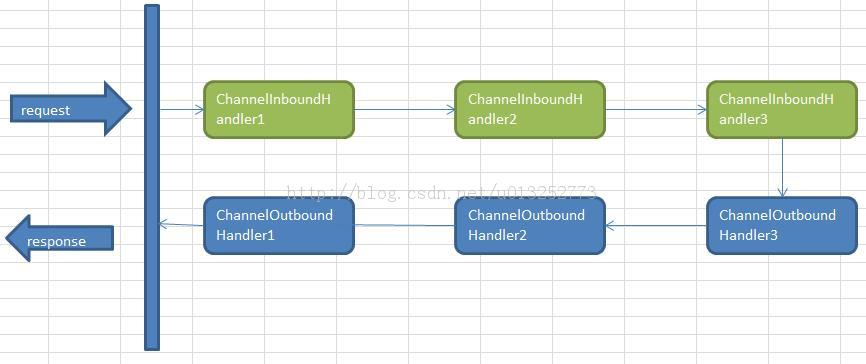
Netty中的所有handler都实现自ChannelHandler接口。按照输出输出来分,分为ChannelInboundHandler、ChannelOutboundHandler两大类。ChannelInboundHandler对从客户端发往服务器的报文进行处理,一般用来执行解码、读取客户端数据、进行业务处理等;ChannelOutboundHandler对从服务器发往客户端的报文进行处理,一般用来进行编码、发送报文到客户端。
Netty中,可以注册多个handler。ChannelInboundHandler按照注册的先后顺序执行;ChannelOutboundHandler按照注册的先后顺序逆序执行,如下图所示,按照注册的先后顺序对Handler进行排序,request进入Netty后的执行顺序为:
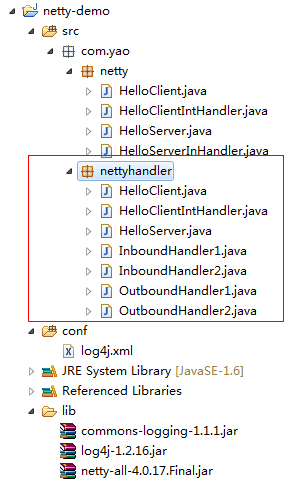
下面例子涉及的类包括:
一、HelloServer:
1
2
3
4
5
6
7
8
9
10
11
12
13
14
15
16
17
18
19
20
21
22
23
24
25
26
27
28
29
30
31
32
33
34
35
36
37
38
39
40
41
42
43
44
45
package com.yao.nettyhandler;
import io.netty.bootstrap.ServerBootstrap;
import io.netty.channel.ChannelFuture;
import io.netty.channel.ChannelInitializer;
import io.netty.channel.ChannelOption;
import io.netty.channel.EventLoopGroup;
import io.netty.channel.nio.NioEventLoopGroup;
import io.netty.channel.socket.SocketChannel;
import io.netty.channel.socket.nio.NioServerSocketChannel;
public class HelloServer {
public void start(int port) throws Exception {
EventLoopGroup bossGroup = new NioEventLoopGroup();
EventLoopGroup workerGroup = new NioEventLoopGroup();
try {
ServerBootstrap b = new ServerBootstrap();
b.group(bossGroup, workerGroup).channel(NioServerSocketChannel.class)
.childHandler(new ChannelInitializer<SocketChannel>() {
@Override
public void initChannel(SocketChannel ch) throws Exception {
// 注册两个OutboundHandler,执行顺序为注册顺序的逆序,所以应该是OutboundHandler2 OutboundHandler1
ch.pipeline().addLast(new OutboundHandler1());
ch.pipeline().addLast(new OutboundHandler2());
// 注册两个InboundHandler,执行顺序为注册顺序,所以应该是InboundHandler1 InboundHandler2
ch.pipeline().addLast(new InboundHandler1());
ch.pipeline().addLast(new InboundHandler2());
}
}).option(ChannelOption.SO_BACKLOG, 128)
.childOption(ChannelOption.SO_KEEPALIVE, true);
ChannelFuture f = b.bind(port).sync();
f.channel().closeFuture().sync();
} finally {
workerGroup.shutdownGracefully();
bossGroup.shutdownGracefully();
}
}
public static void main(String[] args) throws Exception {
HelloServer server = new HelloServer();
server.start(8000);
}
}
二、InboundHandler1:
1
2
3
4
5
6
7
8
9
10
11
12
13
14
15
16
17
18
19
20
21
22
23
24
25
package com.yao.nettyhandler;
import io.netty.channel.ChannelHandlerContext;
import io.netty.channel.ChannelInboundHandlerAdapter;
import org.apache.commons.logging.Log;
import org.apache.commons.logging.LogFactory;
public class InboundHandler1 extends ChannelInboundHandlerAdapter {
private static Log logger = LogFactory.getLog(InboundHandler1.class);
@Override
public void channelRead(ChannelHandlerContext ctx, Object msg) throws Exception {
logger.info("InboundHandler1.channelRead: ctx :" + ctx);
// 通知执行下一个InboundHandler
//ctx.fireChannelRead(msg);
}
@Override
public void channelReadComplete(ChannelHandlerContext ctx) throws Exception {
logger.info("InboundHandler1.channelReadComplete");
ctx.flush();
}
}
三、InboundHandler2:
1
2
3
4
5
6
7
8
9
10
11
12
13
14
15
16
17
18
19
20
21
22
23
24
25
26
27
28
29
30
31
32
33
package com.yao.nettyhandler;
import io.netty.buffer.ByteBuf;
import io.netty.channel.ChannelHandlerContext;
import io.netty.channel.ChannelInboundHandlerAdapter;
import org.apache.commons.logging.Log;
import org.apache.commons.logging.LogFactory;
public class InboundHandler2 extends ChannelInboundHandlerAdapter {
private static Log logger = LogFactory.getLog(InboundHandler2.class);
@Override
// 读取Client发送的信息,并打印出来
public void channelRead(ChannelHandlerContext ctx, Object msg) throws Exception {
logger.info("InboundHandler2.channelRead: ctx :" + ctx);
ByteBuf result = (ByteBuf) msg;
byte[] result1 = new byte[result.readableBytes()];
result.readBytes(result1);
String resultStr = new String(result1);
System.out.println("Client said:" + resultStr);
result.release();
ctx.write(msg);
}
@Override
public void channelReadComplete(ChannelHandlerContext ctx) throws Exception {
logger.info("InboundHandler2.channelReadComplete");
ctx.flush();
}
}
四、OutboundHandler1 :
1
2
3
4
5
6
7
8
9
10
11
12
13
14
15
16
17
18
19
20
21
22
23
24
25
package com.yao.nettyhandler;
import io.netty.buffer.ByteBuf;
import io.netty.channel.ChannelHandlerContext;
import io.netty.channel.ChannelOutboundHandlerAdapter;
import io.netty.channel.ChannelPromise;
import org.apache.commons.logging.Log;
import org.apache.commons.logging.LogFactory;
public class OutboundHandler1 extends ChannelOutboundHandlerAdapter {
private static Log logger = LogFactory.getLog(OutboundHandler1.class);
@Override
// 向client发送消息
public void write(ChannelHandlerContext ctx, Object msg, ChannelPromise promise) throws Exception {
logger.info("OutboundHandler1.write");
String response = "I am ok!";
ByteBuf encoded = ctx.alloc().buffer(4 * response.length());
encoded.writeBytes(response.getBytes());
ctx.write(encoded);
ctx.flush();
}
}
五、OutboundHandler2:
1
2
3
4
5
6
7
8
9
10
11
12
13
14
15
16
17
18
19
20
package com.yao.nettyhandler;
import io.netty.channel.ChannelHandlerContext;
import io.netty.channel.ChannelOutboundHandlerAdapter;
import io.netty.channel.ChannelPromise;
import org.apache.commons.logging.Log;
import org.apache.commons.logging.LogFactory;
public class OutboundHandler2 extends ChannelOutboundHandlerAdapter {
private static Log logger = LogFactory.getLog(OutboundHandler2.class);
@Override
public void write(ChannelHandlerContext ctx, Object msg, ChannelPromise promise) throws Exception {
logger.info("OutboundHandler2.write");
// 执行下一个OutboundHandler
super.write(ctx, msg, promise);
}
}
下面是客户端
六、HelloClient:
1
2
3
4
5
6
7
8
9
10
11
12
13
14
15
16
17
18
19
20
21
22
23
24
25
26
27
28
29
30
31
32
33
34
35
36
37
38
39
40
package com.yao.nettyhandler;
import io.netty.bootstrap.Bootstrap;
import io.netty.channel.ChannelFuture;
import io.netty.channel.ChannelInitializer;
import io.netty.channel.ChannelOption;
import io.netty.channel.EventLoopGroup;
import io.netty.channel.nio.NioEventLoopGroup;
import io.netty.channel.socket.SocketChannel;
import io.netty.channel.socket.nio.NioSocketChannel;
public class HelloClient {
public void connect(String host, int port) throws Exception {
EventLoopGroup workerGroup = new NioEventLoopGroup();
try {
Bootstrap b = new Bootstrap();
b.group(workerGroup);
b.channel(NioSocketChannel.class);
b.option(ChannelOption.SO_KEEPALIVE, true);
b.handler(new ChannelInitializer<SocketChannel>() {
@Override
public void initChannel(SocketChannel ch) throws Exception {
ch.pipeline().addLast(new HelloClientIntHandler());
}
});
// Start the client.
ChannelFuture f = b.connect(host, port).sync();
f.channel().closeFuture().sync();
} finally {
workerGroup.shutdownGracefully();
}
}
public static void main(String[] args) throws Exception {
HelloClient client = new HelloClient();
client.connect("127.0.0.1", 8000);
}
}
七、HelloClientIntHandler:
1
2
3
4
5
6
7
8
9
10
11
12
13
14
15
16
17
18
19
20
21
22
23
24
25
26
27
28
29
30
31
32
33
package com.yao.nettyhandler;
import io.netty.buffer.ByteBuf;
import io.netty.channel.ChannelHandlerContext;
import io.netty.channel.ChannelInboundHandlerAdapter;
import org.apache.commons.logging.Log;
import org.apache.commons.logging.LogFactory;
public class HelloClientIntHandler extends ChannelInboundHandlerAdapter {
private static Log logger = LogFactory.getLog(HelloClientIntHandler.class);
@Override
// 读取服务端的信息
public void channelRead(ChannelHandlerContext ctx, Object msg) throws Exception {
logger.info("HelloClientIntHandler.channelRead");
ByteBuf result = (ByteBuf) msg;
byte[] result1 = new byte[result.readableBytes()];
result.readBytes(result1);
result.release();
ctx.close();
System.out.println("Server said:" + new String(result1));
}
@Override
// 当连接建立的时候向服务端发送消息 ,channelActive 事件当连接建立的时候会触发
public void channelActive(ChannelHandlerContext ctx) throws Exception {
logger.info("HelloClientIntHandler.channelActive");
String msg = "Are you ok?";
ByteBuf encoded = ctx.alloc().buffer(4 * msg.length());
encoded.writeBytes(msg.getBytes());
ctx.write(encoded);
ctx.flush();
}
}
八、总结:
在使用Handler的过程中,需要注意:
1、ChannelInboundHandler之间的传递,通过调用 ctx.fireChannelRead(msg) 实现;调用ctx.write(msg) 将传递到ChannelOutboundHandler。
2、ctx.write()方法执行后,需要调用flush()方法才能令它立即执行。
3、ChannelOutboundHandler 在注册的时候需要放在最后一个ChannelInboundHandler之前,否则将无法传递到ChannelOutboundHandler。
4、Handler的消费处理放在最后一个处理。